Skip to content


Agricultural machinery operates under extreme conditions: dust, mud, heat, and heavy loads for hours on end. In this environment, filters are not a secondary aspect of maintenance.
They are the first line of defense for the engine, the hydraulic system, and the transmission against contamination that, if left unchecked, shortens the equipment’s service life and drives up repair costs.
In this guide, we explain what types of filters a tractor or combine harvester needs, when to replace them, and how to choose the correct part number based on the application. This is a useful read whether you’re a maintenance technician or a farm manager looking to reduce downtime for your fleet.

Why Filtration Is Critical in Agricultural Machinery
A tractor working in an open field takes in dust, plant particles, and dirt every hour it operates. If those particles reach the engine, the hydraulic system, or the transmission, wear and tear increases dramatically.
Manufacturers of industrial filters estimate that more than 70% of premature breakdowns in mobile machinery are caused by inadequate filtration or by filters that are not replaced at the recommended intervals.
Added to this is the economic pressure on the sector: a machine that is out of service during the harvest season not only incurs repair costs but also results in a loss of productivity during a period of time that cannot be recovered. Keeping the filters in good condition is, therefore, as much a matter of agronomic management as it is of mechanical maintenance.
Types of Filters in Agricultural Machinery
Air filter
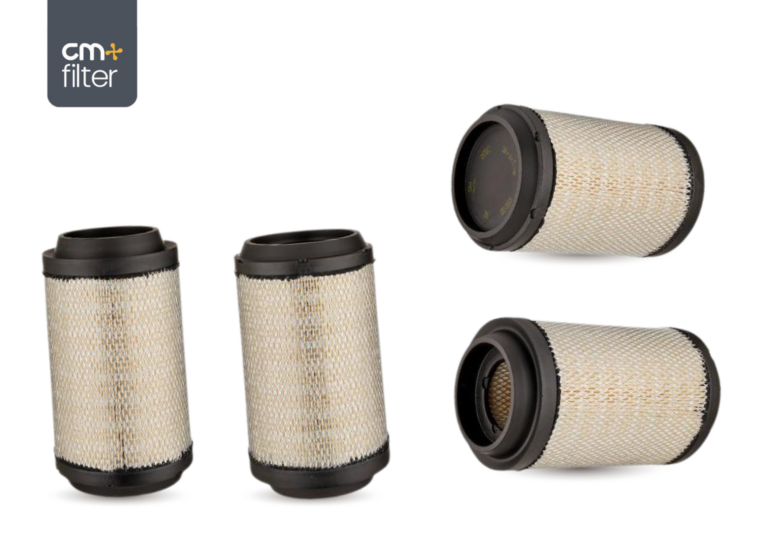
This is the filter that承受s the heaviest workload in agricultural settings. A tractor’s diesel engine requires large volumes of clean air for efficient combustion. When the air filter becomes clogged, the engine loses power, consumes more fuel, and emits more pollutants. In conditions of heavy dust—such as planting, harvesting, or working on dry soil—the air filter can reach the limit of its capacity well before the standard maintenance interval.

Most modern tractors are equipped with an air restriction indicator that alerts the operator when the primary filter needs to be cleaned or replaced.
It is essential not to ignore this. The secondary or backup filter should not be cleaned or reused: its purpose is to protect the engine if the primary filter fails, and it must be replaced whenever the primary filter is serviced.
Engine Oil Filter
It traps metal particles, soot, and combustion byproducts generated by the engine itself during operation. Contaminated oil acts as an abrasive that wears down bearings, cylinder liners, and the camshaft.
Changing the oil without replacing the filter is a common mistake: once the engine starts, the clogged filter will release the trapped contaminants into the new oil.

The replacement interval is specified by the equipment manufacturer, but under conditions of intensive use—more than 10 hours a day, high temperatures—it is advisable to shorten it.
At Filtros Castelló, we carry parts that are compatible with OEM specifications for John Deere, New Holland, Fendt, Kubota, and SAME tractors.
Fuel filter
Modern diesel engines with common-rail injection systems operate at very high pressures and with minimal mechanical tolerances. A particle of dirt as small as 5 microns can damage an injector.
The diesel filter traps these particles and, in many cases, also the water emulsified in the fuel—a common problem in rural storage tanks subject to extreme temperature fluctuations.

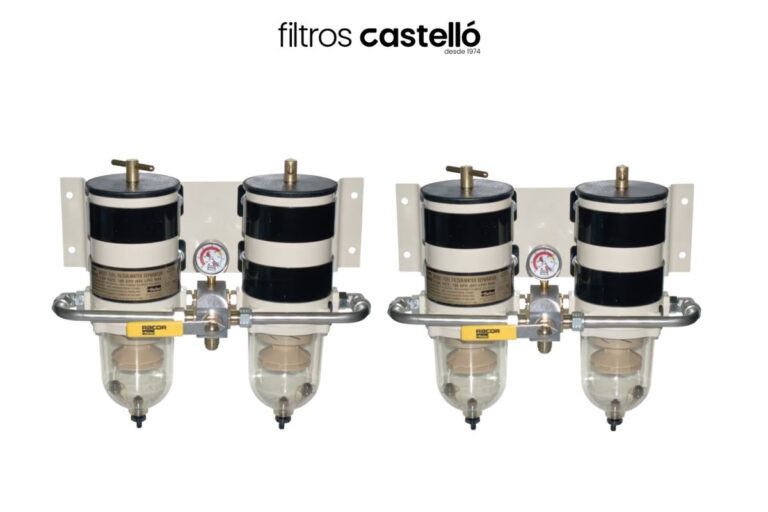
Some systems have a primary and secondary fuel filter installed in series. The primary filter acts as a prefilter with a water separator; the secondary filter is the fine filter that directly protects the pump and the injectors. Both should be replaced according to the manufacturer’s maintenance schedule.
Hydraulic filter
A tractor’s hydraulic system powers the three-point hitch, the implement cylinders, and the power steering. Contamination of the hydraulic oil by particles or water causes wear on pumps, valves, and actuators, resulting in repairs that can easily exceed several thousand euros.
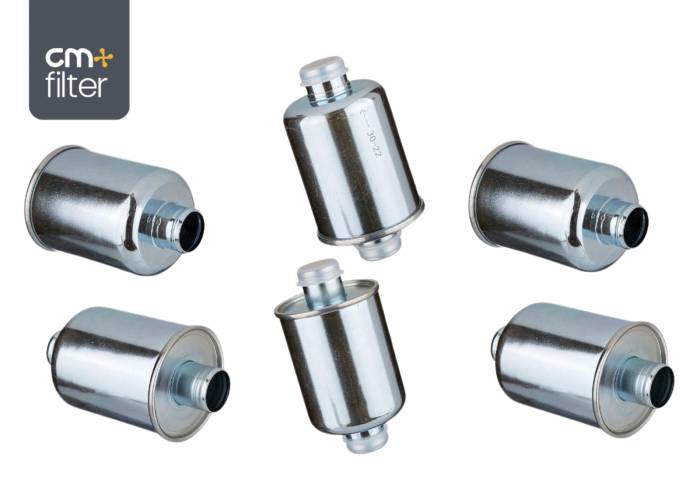
We offer a wide selection of hydraulic filters designed for installation in the suction, pressure, or return lines. These units ensure that the fluid maintains the level of purity required by the manufacturer, safeguarding the integrity of the entire circuit, from the main pump to the most sensitive actuators.
Transmission filter
In tractors with automatic or CVT transmissions, the transmission filter protects gears, bearings, and clutches from metal debris generated by normal wear and tear on the system.
Its function is to keep the oil free of abrasive particles so that lubrication is effective and the system pressure remains stable.

There are two types based on their location: internal (inside the transmission housing, more difficult to replace) and external (accessible without opening the housing). In both cases, when the filter is clogged, clear signs appear: erratic shifting, noises from the transmission, or a loss of responsiveness in the system. Ignoring these signs can lead to a complete transmission overhaul. We suggest you review our specialized catalog of transmission filters to find the ideal compatible part that ensures the operational integrity of your machinery.
Cabin filter
The operator spends entire workdays inside the tractor cab in environments filled with dust, pollen, and, in many cases, pesticide residues. The cabin filter traps these particles and protects the driver’s health. In models with a pressurized cabin climate control system, regularly replacing the filter is especially critical for maintaining the positive pressure that prevents external contaminants from entering.
Filters for John Deere, New Holland, and other brands of tractors
One of the most frequently asked questions at the shop is whether compatible filters offer the same protection as the original equipment ones.
A compatible filter, made with equivalent filter media and meeting the equipment manufacturer’s specifications for flow rate, pressure, and micron rating, offers the same level of protection at a lower cost.
At Filtros Castelló, we carry more than 20,000 active SKUs covering agricultural machinery from the leading brands on the market: John Deere, New Holland, Fendt, Kubota, Case IH, Massey Ferguson, CLAAS, SAME, and many others.
Under our own brand CM Filter, we offer solutions that meet industry standards for the professional sector, ensuring complete engine protection under severe operating conditions.
We have technical specialists who determine the exact equivalence based on the specific characteristics of the equipment and its operating environment.
How often should you change the filters on a tractor?
The maintenance intervals specified by the equipment manufacturer are a starting point, not the only criterion. Actual working conditions may require shorter intervals. As a general guideline for heavy-duty agricultural machinery:
- Air filter: Check every 250–500 hours, or sooner if the restriction indicator requires it.
- Engine oil filter: every 500 hours or at the time of the oil change.
- Fuel filter: every 500–1,000 hours, depending on the equipment and the quality of the diesel fuel.
- Hydraulic filter: every 1,000–2,000 hours or every season of continuous use.
- Transmission filter: every 1,000–2,000 hours for automatic and CVT transmissions.
- Cabin filter: once or twice per season, especially when working with pesticides.
In extremely dusty conditions—sandy soils, grain harvesting, work in dry fields during the Mediterranean summer—all these intervals should be adjusted downward. A periodic visual inspection of the filter’s condition remains the best tool for making this decision.
How to Identify the Right Filter for Your Machinery
Identifying the correct filter requires, at a minimum, three pieces of information: the exact make and model of the equipment, the year or model series, and the type of filter needed (air, oil, fuel, hydraulic, or transmission). With that information, it is possible to cross-reference the manufacturer’s OEM part number with the compatible part numbers available in stock.
At Filtros Castelló, we provide specialized technical support to help you accurately identify your components. We invite you to contact us with the part number of the current component or the technical details of your machinery; our specialists will determine the most efficient solution. You can also browse our section on filters for agricultural machinery, with product listings organized by equipment type and function, or review our comprehensive catalog of filtration solutions, organized by mechanical system.
Conclusion
Keeping filters in good condition is the most cost-effective maintenance measure for any fleet of agricultural machinery. A filter that costs just a few euros can prevent a repair that would cost thousands. The key is to use the correct part number, replace it at the proper interval, and adjust that interval to actual working conditions.
If you have questions about which filter your tractor or farm equipment needs, please contact us. At Filtros Castelló, we have been advising repair shops, distributors, and farms for decades, offering technical expertise and an extensive catalog of parts for machinery of all brands.