Skip to content


Table of contents
The air filter in a tractor or combine harvester operating in the field works under conditions that are completely different from those of a road vehicle. While a truck’s engine draws in air from a height of one and a half meters above the ground on a highway, the engine of a combine harvester in the midst of a sunflower harvest operates surrounded by a cloud of plant dust, lint, and plant debris that can clog a conventional filter within just a few hours of operation.
Air filter maintenance for agricultural machinery is a discipline in its own right. It isn’t measured in kilometers or months—it’s measured in hours of operation, crop type, daily humidity conditions, and the level of airborne particles in the environment. Treating it as if it were a car air filter is one of the most common mistakes that lead to preventable engine failures.
This article explains how the air filtration system works in tractors and farm equipment, what role the cyclonic prefilter plays, and how to determine when to replace the filter based on the type of operation. If you’d like a more general overview of engine air filters before delving into the specifics of agricultural applications, you can first read our article on what an engine air filter is and how it works.
How the Air Filtration System Works in Tractors and Agricultural Machinery
The diesel engine in a tractor or combine harvester requires large volumes of clean air for combustion. A 150 CV engine can draw in more than 500 liters of air per minute. All that air comes from the outside, along with whatever is in the outside environment at that moment.

The system operates in two or three stages, depending on the equipment:
• Stage 1 — Precleaner or preliminary separator: In high-end tractors and combines, there is an initial cyclonic separation stage that removes the largest and heaviest particles before they reach the main filter.
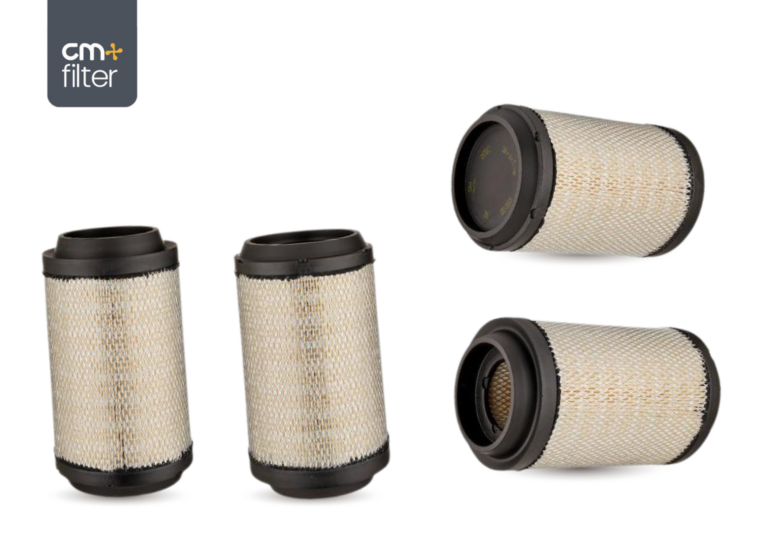
• Stage 2 — Main air filter (outer element): the cylindrical pleated paper filter that performs the actual filtration. It traps particles that the precleaner did not remove and is the element that is replaced periodically.
• Stage 3 — Safety filter (internal element): the second internal element, which is designed to protect the motor in the event that the main filter breaks. It must not be removed to clean the system; without it, the motor is directly exposed to the outside.
The cyclonic prefilter: what it is and why it makes a difference during the campaign
The cyclonic prefilter is the component that makes the biggest difference in working conditions with high levels of dust or organic material in the air. The air begins to rotate inside a cylindrical chamber: the particles, which are denser than air, are pushed toward the walls by centrifugal force and fall into a collection container or directly outside. The cleaner air then continues on to the main filter.
A well-designed cyclonic prefilter can capture between 85% and 95% of particles before they reach the main filter. This can extend the service life of the filter element by five or ten times under high-load conditions.
Tractors and harvesters from brands such as John Deere, New Holland, Case IH, Fendt, Claas, Kubota, and many more… feature cyclonic pre-filtration systems in many models. If you need to identify the compatible air filter for your equipment, check out our CM Filter , you’ll find equivalent part numbers for the leading brands of agricultural machinery.
What type of air filter do tractors and farm equipment use?
The standard filter element in agricultural machinery is the pleated paper cylindrical filter. Its design maximizes the filter surface area, and its material—cellulose fiber or cellulose/synthetic paper—traps fine particles with low pressure drop.
Choosing the right filter depends not only on its physical dimensions, but also on:
• Filtration efficiency, expressed in microns or as a percentage of retention.
• Retention capacity: the amount of dust it can accumulate before becoming saturated.
• Compatibility with the unit’s pre-filtration system.
• Compliance with the engine manufacturer’s technical specifications.
When to Change Your Tractor’s Air Filter: A Guide by Type of Operation

The shift schedule cannot be determined based solely on the hours shown on the clock: the work environment is the deciding factor.
Grain harvest (wheat, barley, oats)
Threshing generates very high concentrations of fine grain and straw dust, especially under low-humidity conditions. On combines operating in heavy dust, the main filter may need to be checked every 50–100 hours. The restriction indicator is the guide, not the hour meter.
Sunflower and Corn Harvest
Sunflowers generate lint, calyx dust, and light debris. Corn produces leaf dust and rachis fragments. Cyclonic pre-filters are particularly effective for these crops, but even with them, the main filter must be checked more frequently than under normal conditions.
Tillage in Dry Conditions
Tillage work in the summer, when the soil is dry and powdery, is one of the most demanding conditions for the air filter. Inspection intervals should be reduced to 100–150 hours, and the cyclonic prefilter should be cleaned frequently.
Wet Conditions and Working on Green Surfaces
When planting, fertilizing, or applying pesticides to damp plants, the suspended particulate load is much lower. The manufacturer’s standard intervals—typically 250–500 hours—are more reasonable, although the condition of the filter should always be checked during each periodic inspection.
The Restriction Indicator: The Tool You Can’t Afford to Ignore
Most tractors and harvesters are equipped with an air restriction indicator that measures the vacuum created in the intake when the filter is clogged. When the warning signal is activated, the filter has reached the level of saturation at which airflow is significantly restricted: power drops, fuel consumption rises, and internal wear increases.
The restriction indicator is the definitive parameter for managing filter replacement, taking precedence over the hour meter or the calendar. To learn more about how engine filtration affects the overall performance of the equipment, see also our engine filtration solutions, where you’ll find technical information organized by system and machine type.