Skip to content


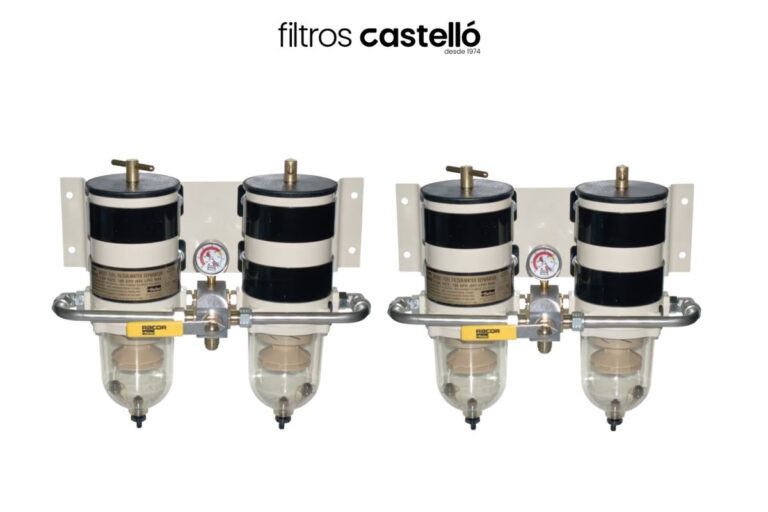
When people in the industry refer to a “complete diesel fuel filter,” they are not actually talking about a single part. It consists of a set of components that work together to protect the engine: the prefilter, the decanter (or water separator), and the main filter, all mounted on a common bracket or housing.
At Filtros Castelló, we have been in the spare parts business since 1974, After specializing in industrial filtration around 1994, we gradually expanded to include filtration systems for agricultural machinery, public works equipment, and vehicle fleets, with a warehouse spanning over 2,000 m² and more than 20,000 active product listings.
In this article, we review the function of each component in the assembly, why it is not advisable to replace them individually without technical justification, and how to choose the right combination based on the industry and working conditions.
What Is a Complete Diesel Fuel Filtration System?
Diesel fuel goes through several stages before reaching the injection pump: it leaves the tank, passes through the prefilter, then through the decanter, and finally through the main filter, located in the engine’s filter assembly. Each stage traps a different type of contaminant—coarse particles, water, fine particles—and none of them can replace the others. That’s why, when a customer asks for a “complete diesel fuel filter,” what they need in most cases is to have the entire assembly inspected, not just the final filter element.

The diesel fuel prefilter: the first line of defense
The prefilter is the system’s first stage of filtration. Its function is to trap the coarsest particles—rust from the tank, debris from the fuel supply, and dust generated during refueling in the field or on a job site—before they reach the rest of the system. In machinery that operates in very dusty environments or that refuels from drums or tankers—as is often the case with public works machinery—the prefilter significantly extends the service life of the main filter and reduces the risk of premature clogging.
The Decanter: Why Water Is Diesel Fuel’s Number One Enemy
Water in diesel fuel is by far the most common cause of malfunctions in diesel injection systems. It can enter through condensation in tanks that remain low on fuel for long periods, due to prolonged outdoor storage, or as a result of low-quality fuel. The decanter—also called a water separator—takes advantage of the difference in density between diesel fuel and water to trap the water in a cup or tray, preventing it from reaching the pump and the injectors.
Failing to drain the fuel separator regularly is one of the most common causes of internal corrosion and the growth of microorganisms in stored fuel. You can learn more about this topic in our article on how often the fuel filter should be changed, which also discusses the difference between gasoline and diesel systems.
The main filter: the engine’s last line of defense
The main filter traps the finest particles—those that neither the prefilter nor the separator can stop. This is especially critical in engines with common-rail injection systems, where injector tolerances are measured in microns and any remaining contaminants can cause a costly failure. A main filter properly sized for the engine and operating conditions is the final safeguard before the fuel reaches the combustion chamber.
The mount or head: why the assembly functions as a system
The housing—or head—is the component that houses and connects the prefilter, the decanter, and the main filter. Combining components from different sources without verifying that they fit properly into the housing is one of the most common causes of leaks, poor sealing, and pressure drops. That is why, at our fuel filtration solution, , we treat the entire assembly as a system—not as individual parts—and verify the actual compatibility of all its components.
How to Choose a Filtration System Based on Industry and Equipment
Not all diesel fuel filtration systems are the same, because not all working environments are the same. Agricultural and public works machinery often operate in very dusty conditions and with less controlled refueling practices, which makes the prefilter especially important. Fleets and power generation equipment that store diesel for long periods in fixed tanks or tankers are more vulnerable to condensation, making the decanter a key component. In any case, recommendations are always based on the engine specifications and the manufacturer’s maintenance schedule, adjusted to the equipment’s actual usage intensity.

CM Filter: Compatible Sets That Combine Functionality and Efficiency
Filtros Castelló distributes its own brand CM Filter since 1994. As a technical solution for various industries, it also offers a line of diesel fuel filtration assemblies with a range of specifications. It is a reliable choice, as the brand ensures that the selection of the appropriate assembly is based on technical specifications, manufacturing characteristics, and actual conditions of use.
How often should I inspect or replace the entire assembly?
There is no universal interval that applies to all diesel fuel filter sets: it depends on the equipment manufacturer, the number of hours or kilometers of use, and the quality of the fuel available in the work area.
As a general rule, the decanter should be flushed much more frequently than the rest of the system—often on a weekly basis for equipment operating outdoors—while the prefilter and main filter should be replaced according to the manufacturer’s maintenance schedule or upon detecting the first signs of reduced performance.
Frequently Asked Questions About the Diesel Fuel Filtration System
Do you need help choosing the right diesel fuel filtration system for your machinery?
Contact our team and we’ll advise you based on your industry and your specific equipment.
Can we find various types of complete diesel filters at Filtros Castelló?
Yes, at Filtros Castelló we carry a wide variety of complete diesel fuel filters. We’re located in Massanassa, Valencia, and you can contact us in person or by email at info@filtroscastello.com