Skip to content


The transmission is the system that transfers power from the engine to the wheels or auxiliary equipment. Without it, the machine won’t move. And without a transmission filter in good condition, the transmission wears out sooner than expected, accumulates contaminants, and eventually fails at the worst possible moment: in the middle of operation.

Despite its importance, the transmission filter is one of the most often overlooked maintenance items in industrial, agricultural, and public works fleets. In this article, we explain how it works, what types are available, how to tell when it has reached the end of its service life, and how often it should be replaced in different types of machinery.
What is a transmission filter, and what is it used for?
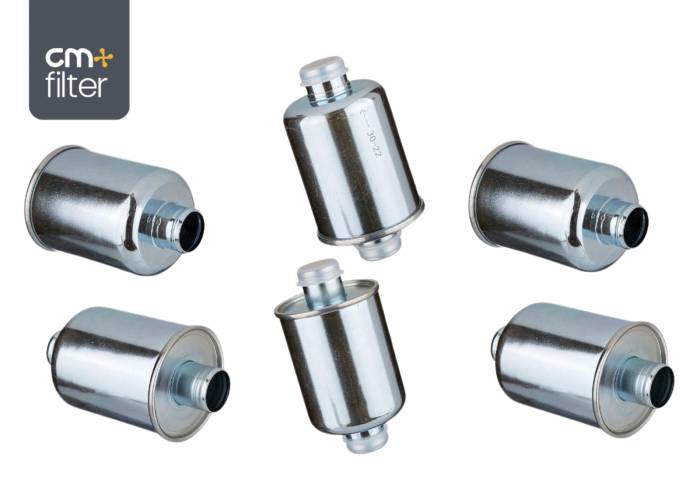
The transmission filter acts as a strainer that traps metal particles, dirt, and wear debris before the lubricating fluid reaches the internal mechanisms of the transmission. It is typically located above the transmission pan, connected to the return line that feeds the oil pump.
The transmission system naturally generates metal shavings during operation: each gear shift causes friction between parts, which releases small particles. If these particles circulate freely in the oil, they act as abrasives that accelerate wear on gears, bearings, clutches, and control valves. The filter is the barrier that prevents this from happening.

Proper filtration helps preserve lubrication, maintain system pressure, and reduce internal wear. That is why choosing the right transmission filter—and replacing it at the right time—is one of the maintenance decisions that has the greatest impact on the system’s durability.
Types of Transmission Filters
Internal transmission filter
It is located inside the gearbox. Replacing it requires opening the gearbox, which calls for technical expertise and specialized tools. For this reason, on equipment with an internal filter, it is recommended to shorten the preventive maintenance interval for the fluid to compensate for the difficulty in accessing the filter. In automatic transmissions with an internal filter, the standard maintenance interval ranges from 1,000 to 1,500 hours for industrial machinery.
External transmission filter
It is the most common type in mobile machinery and accounts for more than 85% of the fleet. It is accessible without having to open the housing, which makes it easy to inspect and replace. Whenever transmission fluid is changed, the external filter should also be replaced. Reusing it after an oil change negates much of the benefit of the maintenance.
Filter for CVT transmission and integrated hydraulic system
CVT (continuously variable transmission) systems and systems with integrated hydraulics combine the functions of the transmission and power steering in a single oil circuit. In these cases, filtration must be particularly precise because it protects not only the gears but also the hydraulic actuators, valves, and hydraulic motors. You can check out our range of hydraulic filters if your equipment combines both systems.

Symptoms of a Clogged Transmission Filter
The transmission filter does not have a saturation indicator as visible as the air filter’s, but the system gives clear signals when filtration is no longer effective:
- Irregular, delayed, or jerky gear shifts: The hydraulic system that activates the gear shifts is not receiving the flow of clean oil it needs.
- Noises from the transmission while shifting gears or while driving: These may indicate wear caused by contaminated lubricant.
- Loss of response or a slipping sensation: the pressure in the circuit drops when the filter is clogged.
- Abnormal vibrations when shifting gears or accelerating.
- Transmission fluid leaks: Although they do not always indicate that the filter is clogged, they are a sign that the system needs to be inspected.
- Warning light or error code on the panel: Modern equipment monitors the fluid’s pressure and temperature.
When these signs appear, it’s best to have the system inspected before damage occurs to more expensive components. A complete transmission repair can cost many times more than replacing the filter in a timely manner.
How often should the transmission filter be replaced in industrial and agricultural machinery?
The oil change interval depends on the type of transmission, hours of use, operating conditions, and the manufacturer’s recommendations. As a general guideline:
- Automatic transmissions with an external filter: every 1,000–2,000 hours of operation in mobile machinery, or as specified by the manufacturer.
- Automatic transmissions with internal filters: preventive fluid maintenance every 1,000–1,500 hours; filter replacement during every major repair.
- CVT transmissions: every 1,000–1,500 hours, or as specified by the equipment manufacturer.
- Agricultural tractors with an integrated hydraulic transmission: generally every 1,000–2,000 hours, coinciding with the hydraulic oil change.
- Public works machinery (excavators, loaders, motor graders): every 1,000 hours under normal conditions; every 500–750 hours under demanding operating conditions.
In all cases, actual operating conditions may require shorter intervals: extreme temperatures, continuous operation at maximum capacity, frequent starts and stops, or operation in highly polluted environments accelerate filter wear. The manufacturer’s schedule is a starting point, not a limit.
Transmission filters for various types of machinery
At Filtros Castelló, we offer transmission filters compatible with machinery from various brands and for a range of applications, always based on the part number and conditions of use. Our line of transmission filters covers the main industries:
- Agricultural machinery: tractors, combines, grape harvesters, and precision farming equipment with automatic transmissions and CVTs.

- Public works: excavators, wheel loaders, motor graders, compactors, and earthmoving equipment.
- Mining and Quarrying: Loading and transport equipment operating under extreme conditions of dust, vibration, and temperature.
- Selection and Maintenance: Forklifts, Reach Trucks, and Warehouse Equipment with Hydraulic Drives.
- Transportation and Fleets: Trucks and commercial vehicles with automatic transmissions.
For each application, the selection criteria combine flow rate, operating pressure, appropriate micron rating, and compatibility with the system’s oil type. Our technical team provides guidance on identifying the correct part number when the original part is unavailable or a compatible part of equivalent quality is needed.
Original filter or compatible filter?
A compatible replacement filter, manufactured with equivalent filter media and meeting the equipment manufacturer’s technical specifications (flow rate, pressure, micron rating), offers the same level of protection as the original at a lower or higher cost. Our private label , CM Filter, is specifically designed to meet these needs in industrial, agricultural, and public works machinery, complying with the standards required by manufacturers and industry professionals. When it comes to the industrial sector, it’s important to choose the filter that best suits your machinery and meets the standards required for your operations.
What you should never do is install a generic filter without verifying that its technical specifications are compatible with the system. A filter with the wrong micron rating or insufficient retention capacity will not protect the system, even if it looks exactly like the original.
Conclusion
The transmission filter is a small component that has a huge impact on the system’s durability. Replacing it at the correct interval, using the proper part number, and not ignoring signs of clogging are the three basic rules for avoiding costly repairs and machine downtime at the worst possible moment.
If you need to identify the right transmission filter for your equipment, please contact us. At Filtros Castelló, we have over 20,000 active product listings and technical support to help you find the right solution, regardless of your machinery’s make or model. You can also browse our range of filtration solutions organized by system to find what you need.