Skip to content


In the industrial filtration sector, few decisions seem as simple—and yet as critical—as choosing between an original filter, an equivalent filter , or a compatible filter.
This choice affects not only the price, but also the system’s performance, the service life of the components, and the operational reliability of the equipment. However, the debate is often oversimplified. The technical reality is more complex.
In this article, we analyze what each concept really means and what factors influence the decision-making process depending on the application
Table of Contents
What does it mean for a filter to be genuine?
An original (OEM) filter is one supplied by the equipment manufacturer or by a supplier directly approved by the brand. These filters are designed according to the exact technical specifications of the engine or machinery manufacturer:
- Precise dimensions and tolerances
- Specified filtration rating
- Particle retention capacity
- Structural strength
- Chemical compatibility with specific fluids
In modern diesel engines, for example, an original filter must ensure extremely fine filtration, especially in high-pressure injection systems such as common rail, where internal tolerances are minimal. Choosing an original filter is generally recommended for equipment under warranty or in applications where the manufacturer specifically requires OEM components.
What is an equivalent or compatible filter?
An equivalent filter is one that has been designed to meet the same technical specifications as an original filter, even if it is not manufactured by the equipment manufacturer. It is important to clarify something here: equivalent does not mean a copy. A technically equivalent filter must meet the following requirements:
- Exact dimensions
- Filtration rating (actual micron rating, not estimated)
- Contaminant retention capacity
- Nominal flow rate
- Maximum differential pressure
- Quality of the filter medium
In industrial filtration, many specialized manufacturers develop their own compatible product lines with multiple brands and models, using advanced filter media such as multilayer synthetic microfiber, treated cellulose, or hybrid combinations. When properly designed, these filters can offertechnical performance equivalent to the original.

Equivalence vs. compatibility—they are not the same thing
A common mistake is to assume that if a filter “fits,” it is automatically compatible. True compatibility means that the filter not only has the same external dimensions, but that its technical performance is suitable for the system.
For example:
- A hydraulic filter may have the correct thread and diameter, but it may not be able to withstand the differential pressure in the circuit.
- A fuel filter may fit physically, but it may not provide the necessary water separation capacity.
- An air filter may be the correct size but may not meet the efficiency level required by ISO 16890 or EN 779.
Technical equivalence must be verified using reliable cross-reference tables and actual technical data.
Are equivalent filters reliable?
Reliability does not depend on the label, but rather on the design and quality control. A technically sound filter must meet criteria such as:
- Quality Control in Production
- Filtration Efficiency Validation
- Differential Pressure Tests
- Technical Certifications
- Traceability of the Filter Media
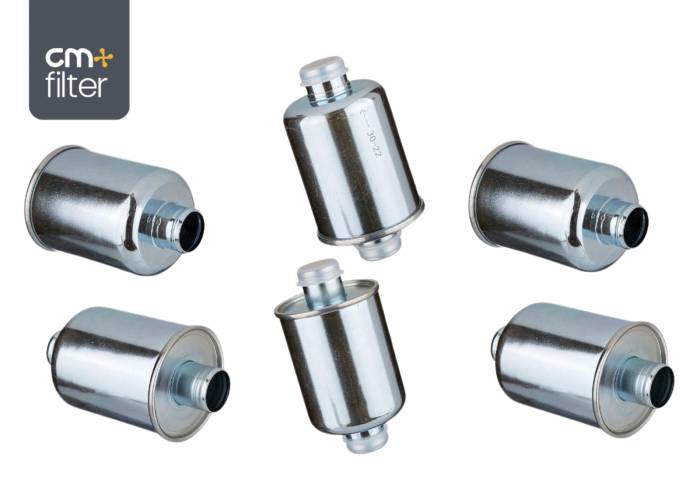
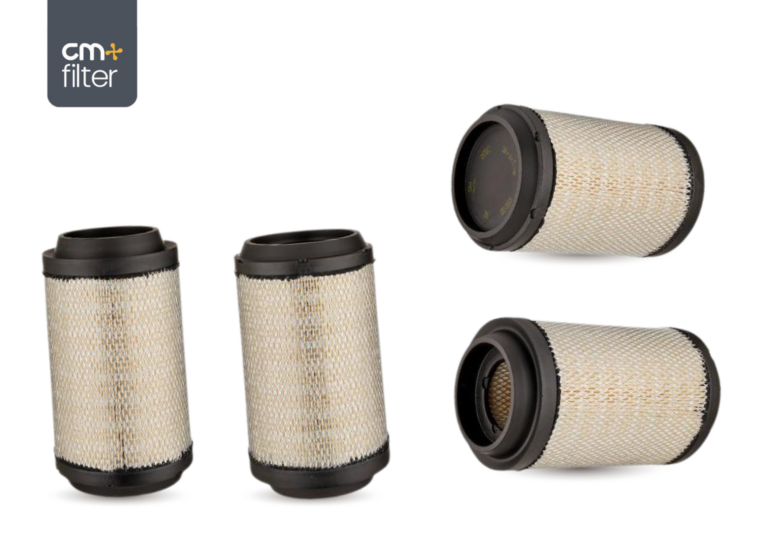
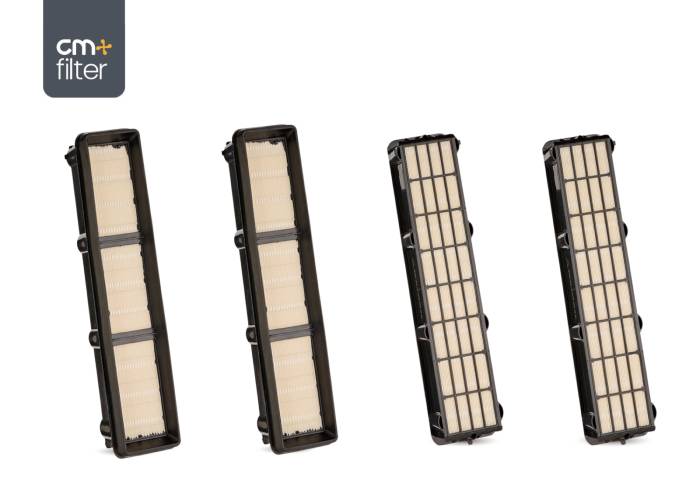
In demanding industrial applications, heavy machinery, hydraulic systems, and high-pressure diesel engines, the quality of the filter media is critical. At Filtros Castelló, we work with both official brands and our own CM Filter line, developed to offer high-quality, compatible solutions for multiple brands and industrial machinery.
CM Filter is not a brand offering a generic product. It is a product line designed according to technical criteria, with quality control and specifications tailored to professional environments where performance and reliability are essential.

When should you choose an original filter, and when should you choose a compatible one?
There is no single correct answer. It depends on several factors:
1. Equipment Status
If the equipment is under warranty, it may be advisable to use an OEM filter.
2. Application Critical Level
In extremely sensitive systems or those with specific contractual requirements, the original document may be required.
3. Cost Optimization in Preventive Maintenance
In planned maintenance programs, a equivalent filter can offer the same technical performance while optimizing operating costs without compromising safety.
4. Availability and Delivery Times
In certain industrial settings, immediate availability can be key to preventing unplanned downtime.
The decision should be made based on technical advice, not solely on price.
Common Mistakes When Searching for Filter Equivalents
Based on our technical experience, the most common errors are:
- Select based solely on the part number without verifying the specifications.
- Failure to check the actual filter clearance.
- Ignore the maximum allowable differential pressure.
- Do not check for chemical compatibility with the fluid.
- Prioritize price over the quality of the filter media.
It is important to note that these specifications may vary from one manufacturer to another.
In systems such as common-rail diesel engines or high-pressure hydraulic circuits, a wrong decision can lead to premature wear, loss of performance, or costly breakdowns.

How to Verify the Equivalence and Compatibility of a Filter
When discussing equivalent filters or filter compatibility, it is important to understand that it is not simply a matter of matching a part number. A valid technical equivalence must verify:
- Exact dimensions (height, outer diameter, and inner diameter)
- Type of filter media
- Actual filtration pore size
- Nominal flow rate
- Maximum differential pressure
- Fluid compatibility (oil, air, fuel, hydraulic fluid)
A common mistake is to assume that two cross-references automatically guarantee the same performance. In reality, filter compatibility must be evaluated based on the equipment’s actual operating conditions.
In industrial settings, where loads, temperatures, and pressures can vary significantly, choosing a suitable equivalent filter requires reviewing the complete technical specifications, not just the product code.
That is why working with a specialized provider ensures that the equivalence is not merely nominal, but functional and secure for the system.

Choose based on technical criteria, not just on recommendations
In industrial filtration, the decision between an original, equivalent, or compatible filter should not be based solely on brand or price, but on actual compliance with the system’s technical specifications.
Filter equivalencies and technical compatibility are useful tools when properly validated. However, a cross-reference alone does not guarantee the same performance unless parameters such as mesh size, retention capacity, differential pressure, or filter media quality are analyzed.
Both an original filter and an equivalent filter can deliver excellent results when selected properly. What really matters is that the filter is designed to operate under the equipment’s actual operating conditions and that it meets the required technical standards.
At Filtros Castelló, we operate based on this approach: technical consulting, compatibility testing, and solutions that combine official brands with our own product line CM Filter, developed to deliver performance, reliability, and safety in industrial applications.